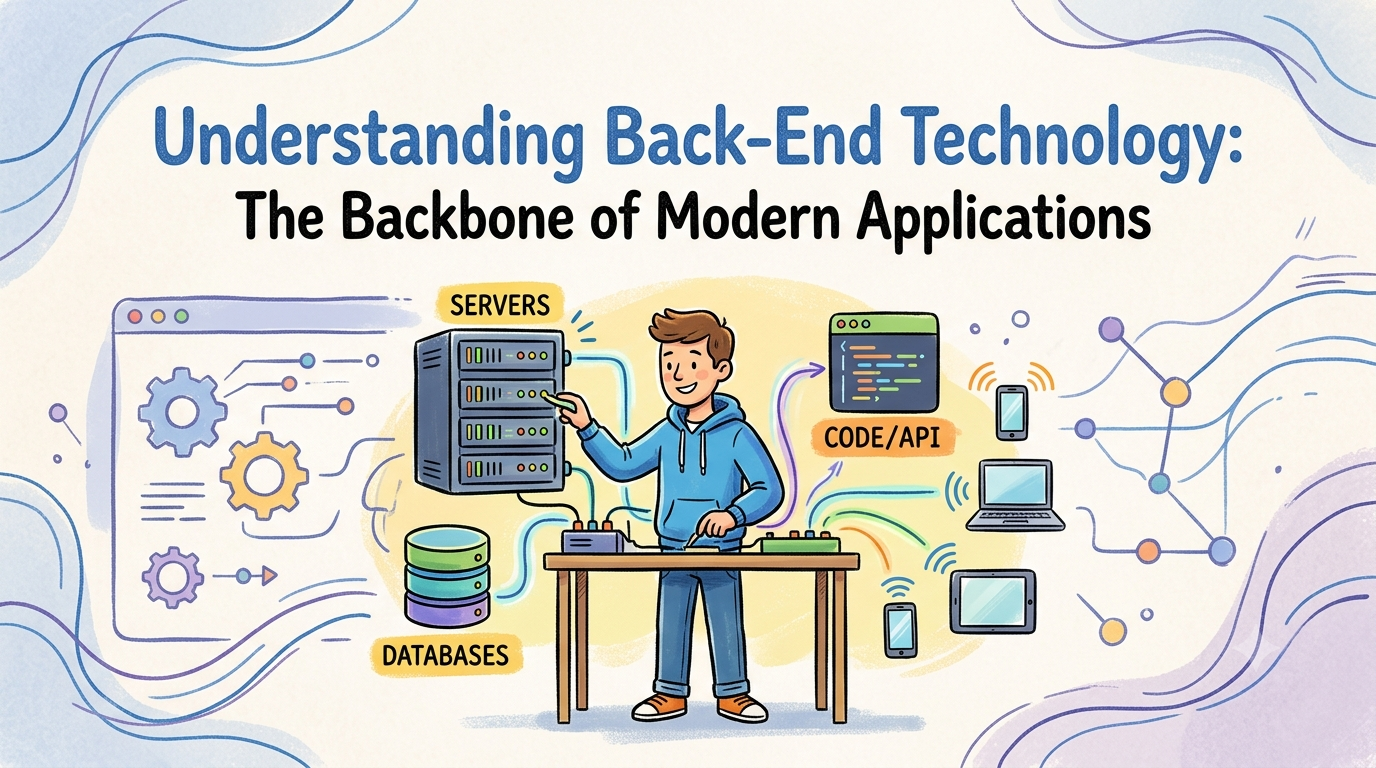
Introduction to Back-End Technology
Back-end technology refers to the server-side of software applications, encompassing all activities that occur behind the scenes to deliver a seamless user experience. This includes managing databases, server logic, application integration, and providing an interface for front-end applications. Unlike front-end development, which deals with the visual aspects of a website or application that users interact with directly, back-end technology focuses on the underlying systems that process and manage data. In essence, it acts as the backbone that supports the front-end interface.
The role of back-end technology is crucial in modern software development, as it is responsible for ensuring data is processed and delivered efficiently. Back-end developers utilize various programming languages such as Python, Ruby, Java, and PHP to create application logic and enable server communication. Additionally, they often work with database management systems like MySQL, PostgreSQL, and MongoDB, which are essential for storing and retrieving data dynamically based on user requests.
Understanding the difference between back-end and front-end development is vital for anyone interested in the software development lifecycle. While front-end developers are more concerned with the aesthetics and user interactions, back-end developers focus on performance, security, and data management. This distinct separation of concerns allows teams to specialize and optimize each component of the application, ultimately leading to a more robust and efficient system.
As applications become increasingly complex, the significance of back-end technology continues to grow. With the advent of cloud computing, microservices architectures, and APIs, the landscape of back-end development is ever-evolving. These advancements enable developers to create more scalable, maintainable, and responsive applications, highlighting the importance of back-end technology in the realm of software development.
Key Components of Back-End Architecture
Back-end architecture serves as the crucial framework that enables applications to function effectively. It consists of several key components including servers, databases, APIs, and frameworks, each playing a distinct role in the overall performance and scalability of an application.
Servers are the backbone of back-end technology, responsible for processing requests from users and delivering the necessary responses. They host websites and applications, managing the resources required for smooth operations. Popular server technologies include Apache and Nginx, which are widely utilized due to their reliability and support for various programming languages.
Databases are another integral component, providing a structured way to store and manage data. They ensure that the necessary information is readily available for applications to retrieve, manipulate, and display to users. Two major types of databases include relational databases, such as MySQL and PostgreSQL, and NoSQL databases like MongoDB and Cassandra. The choice between these options often depends on the nature of the application and the type of data it handles.
APIs (Application Programming Interfaces) are essential for enabling communication between different software components. They provide a set of protocols and tools that allow different systems to interact seamlessly, facilitating data exchange and functionality. RESTful and GraphQL APIs are some of the popular choices among developers due to their flexibility and ease of use.
Frameworks serve as foundational platforms for developing applications, streamlining the coding process by providing pre-built components and tools. Popular back-end frameworks such as Node.js, Django, and Ruby on Rails enhance productivity by simplifying common tasks and ensuring best practices in coding. Each of these components is interrelated and plays a vital role in the efficiency and functionality of modern applications.
Popular Back-End Programming Languages
Back-end development is a crucial aspect of modern applications, and various programming languages dominate this field. Among the most widely used languages are Python, Java, Ruby, Node.js, and PHP. Each language possesses unique strengths and weaknesses, making them suitable for different types of projects.
Python stands out for its simplicity and versatility, making it an excellent choice for beginners and experienced developers alike. Its readable syntax supports rapid development, which is particularly beneficial for startups and MVPs (Minimum Viable Products). Additionally, Python has a robust ecosystem with numerous frameworks, such as Django and Flask, driving its popularity in web applications and data-driven projects. However, its performance may not match that of statically typed languages in high-load scenarios.
Java remains a heavyweight in back-end development, recognized for its portability and scalability. It is often the language of choice for enterprise-level applications, thanks to frameworks like Spring. Java’s type safety and strong performance make it suitable for large systems where performance is critical. Nevertheless, its verbosity can lead to longer development times compared to more succinct languages.
Ruby, often associated with the Ruby on Rails framework, highlights developer happiness through its elegant syntax. This language is highly effective for building web applications quickly. However, it may not perform as well under high concurrency, making it less ideal for applications requiring intense scalability. On the other hand, Node.js empowers developers to use JavaScript for back-end programming, facilitating real-time applications and fostering seamless user experiences. Its non-blocking architecture supports high scalability, but it may present challenges in managing asynchronous code.
PHP is integral to web development, notably for server-side scripting. Although its reputation has waned in some circles, it powers a significant portion of the internet, particularly content management systems like WordPress. PHP’s ease of use is offset by its security concerns and performance limitations compared to other languages.
In conclusion, selecting a back-end programming language hinges on the specific requirements of the project, the team’s expertise, and performance considerations. Understanding the nuances of these popular languages can significantly influence the development process and outcomes.
Database Management Systems (DBMS)
In the realm of back-end technology, Database Management Systems (DBMS) serve as crucial infrastructures for data storage, management, and retrieval. DBMS are software systems designed to create, manage, and manipulate databases, which are essential for modern applications. Based on their architecture and data handling capabilities, DBMS can be primarily categorized into two types: relational and non-relational databases.
Relational Database Management Systems (RDBMS) utilize a structured format, employing tables to store data in a predefined schema. This organization allows for complex queries through Structured Query Language (SQL), making RDBMS suitable for applications requiring stringent data integrity and relationship management, such as banking and e-commerce platforms. Popular examples of relational databases include MySQL, PostgreSQL, and Microsoft SQL Server. They excel in handling structured data and support ACID (Atomicity, Consistency, Isolation, Durability) properties, ensuring reliable transactions.
On the other hand, Non-Relational Database Management Systems (NoSQL) cater to applications needing flexibility and scalability. NoSQL databases are schema-less, allowing for the storage of varied data formats—such as documents, key-value pairs, and graphs—making them ideal for Big Data analytics, content management systems, and real-time web applications. Notable examples of non-relational databases are MongoDB, Cassandra, and Redis. Their capacity to accommodate unstructured data and horizontal scaling capability makes them inherently suitable for dynamic and high-volume workloads.
Choosing the appropriate DBMS involves evaluating the specific needs of an application, including scalability requirements, data complexity, and performance benchmarks. Understanding the interplay between back-end technology and database management provides valuable insights into optimizing application performance, data integrity, and user experience. As applications evolve, effective data storage and retrieval strategies become paramount for success, cementing the importance of selecting the right DBMS to match underlying requirements.
Understanding APIs and Their Importance
Application Programming Interfaces (APIs) serve as essential intermediaries that facilitate communication between different software components, particularly the front-end and back-end systems. They define the methods and data formats that applications use to request and exchange information. This streamlined interaction is pivotal in modern application architecture, enabling developers to create seamless user experiences while maintaining robust server-side processes.
Among the various types of APIs, RESTful APIs are particularly prominent due to their stateless nature and reliance on standard HTTP protocols. REST (Representational State Transfer) allows developers to interact with web services in a way that is both predictable and easy to understand. Whether it’s fetching user profiles, submitting data, or retrieving resource states, RESTful APIs provide clear endpoints and HTTP methods, which allow for straightforward integration across different platforms. On the other hand, GraphQL, another popular API standard, offers more flexibility. It enables clients to request only the data they need, thereby reducing over-fetching and under-fetching issues that can arise with traditional RESTful services. This capability is particularly beneficial for applications that require dynamic data fetching, as it allows for more efficient network usage.
However, the development of APIs extends beyond their technical specifications. Effective API documentation plays a crucial role in ensuring that developers can easily understand and utilize these interfaces. Comprehensive documentation provides guidance on endpoint structure, request methods, and response formats, thus reducing the learning curve associated with integrating an API. Furthermore, API testing practices are essential to validate both the functionality and security of these interfaces. By employing automated testing and monitoring tools, developers can ensure that APIs perform reliably under various situations, ultimately contributing to a more stable back-end environment.
APIs are indeed the backbone of modern applications, and their significance cannot be overstated. They not only connect different system components but also enable innovations that drive the digital landscape forward.
Frameworks and Tools for Back-End Development
In the realm of back-end development, frameworks and tools play a crucial role in building robust applications efficiently. These frameworks streamline the development process and help developers focus on functionality rather than underlying infrastructure. Among the most prominent back-end frameworks are Django, Flask, Express.js, and Ruby on Rails, each offering unique features designed to enhance productivity and code quality.
Django, a high-level Python web framework, emphasizes rapid development and pragmatic design. With its built-in admin interface, ORM (Object-Relational Mapping), and a host of security features, Django significantly accelerates the development of complex applications. Its “batteries-included” philosophy allows developers to utilize various modules and libraries, fostering rapid prototyping and iteration.
Flask, also a Python-based framework, provides the flexibility of a micro-framework. It is lightweight and modular, making it ideal for small to medium-sized applications. Flask’s simplicity allows developers to choose components as needed without imposing a specific structure, which can be particularly advantageous for those seeking a straightforward approach to back-end development.
Express.js, a fast and minimalist web framework for Node.js, is another significant player in the back-end ecosystem. Its non-blocking architecture allows developers to handle multiple requests efficiently, thereby enhancing application performance. Express.js simplifies the creation of RESTful APIs and integrates seamlessly with various middleware, making it a preferred choice for server-side applications.
Ruby on Rails, known for its “convention over configuration” philosophy, emphasizes rapid application development. By providing numerous standard conventions, it reduces the amount of code required, thus speeding up development time. Rails’ active community continuously contributes to its extensive library of gems, promoting reusable code and best practices in back-end development.
In conclusion, the choice of framework or tool for back-end development can significantly influence the productivity and efficiency of developers. Each framework listed has unique characteristics that cater to different project needs and developer preferences, making it essential for developers to select platforms that align with their specific objectives and technical requirements.
Security in Back-End Development
Security is a fundamental aspect of back-end development, as it serves as the foundation for safeguarding application data and services. The ever-evolving landscape of technology brings with it a plethora of security vulnerabilities that developers must address to protect user information and maintain system integrity. Among the most prevalent threats are SQL injection and cross-site scripting (XSS).
SQL injection occurs when an attacker inserts or “injects” malicious SQL statements into an entry field, allowing unauthorized access to a database. This type of security breach can lead to stolen data, data corruption, or even deletion of entire databases. To mitigate the risk of SQL injection, developers should adopt the practice of using prepared statements with parameterized queries, which separates SQL code from user input, thus preventing potential exploits.
Cross-site scripting (XSS) is another significant vulnerability, where attackers inject malicious scripts into web applications that are then executed by the browser of unsuspecting users. XSS exploits can lead to session hijacking and data theft. Protecting against XSS requires thorough validation and sanitization of all user inputs, along with employing Content Security Policy (CSP) headers to help prevent the execution of unauthorized scripts.
A robust security framework necessitates a holistic approach, incorporating best practices such as stringent validation and authentication processes. Input validation ensures that data being entered into the system is consistent with expected formats, while authentication verifies that users are who they claim to be. Adopting multifactor authentication (MFA) can significantly enhance security by adding an extra layer of protection beyond just passwords.
In conclusion, ensuring security in back-end development is integral to preserving application data and maintaining user trust. By understanding common vulnerabilities and implementing best practices, developers can significantly reduce risks and offer safe, reliable applications to users.
Scalability and Performance Optimization
In today’s fast-paced digital landscape, scalability and performance optimization have become essential components of back-end technology, ensuring that applications can handle growing user demands and increased data throughput effectively. Scalability refers to the capability of a system to grow and manage increased load without compromising performance. This is particularly important as businesses expand and seek to accommodate more users or transactions.
One primary method for achieving scalability is through horizontal scaling, which involves adding more servers to a system rather than upgrading existing ones. This strategy allows applications to distribute the load across multiple servers, thereby improving response times and reducing the risk of bottlenecks. Additionally, vertical scaling—upgrading the existing hardware such as increasing CPU or memory—also plays a role, though it may have limitations in terms of cost and maximum capacity.
Performance optimization goes hand-in-hand with scalability. Caching is one effective technique that significantly enhances application performance. By storing frequently accessed data in a temporary storage location, systems can reduce the time it takes to retrieve this data on future requests. There are various levels at which caching can be implemented, such as server-side caching, where data is stored within the web server, or client-side caching, where the user’s browser retains certain information. Utilizing open-source caching solutions, such as Redis or Memcached, can also lead to better performance outcomes.
Moreover, load balancing is another critical technique in ensuring optimal performance. It involves distributing incoming traffic evenly across multiple servers, thus preventing any single server from becoming a point of failure. This not only improves response times but also enhances the overall reliability of the application. By leveraging these strategies—scaling through additional resources, implementing effective caching mechanisms, and managing traffic with load balancing—developers can create robust back-end systems that efficiently manage increased loads while maintaining high performance throughput.
The Future of Back-End Technology
The evolution of back-end technology is a continuous process marked by rapid innovations and emerging trends that are redefining how applications are developed and maintained. One notable trend is the adoption of serverless architectures, which allow developers to build and run applications without the complexity of managing server infrastructure. This shift leads to a more efficient allocation of resources, significantly reducing operational costs while enhancing scalability. With serverless computing, developers can focus more on writing code and less on the underlying infrastructure, making it a compelling choice for modern application development.
Another significant trend reshaping back-end development is the microservices architecture. This approach encourages the creation of applications as small, independently deployable services that communicate with each other via APIs. The microservices model promotes greater flexibility, easier debugging, and the ability to scale individual components as needed. As organizations increasingly seek to improve their deployment processes and enhance user experience, embrace microservices will likely continue to grow, solidifying its position as a critical component of back-end technology.
Moreover, artificial intelligence (AI) is playing an increasingly pivotal role in back-end development. By integrating AI and machine learning into back-end processes, developers can automate various tasks such as data management and predictive analysis, improving overall operational efficiency. AI can also enhance security protocols, swiftly identifying anomalies and potential threats. As machine learning frameworks and tools become more accessible, we can expect to see a greater emphasis on intelligent systems within back-end infrastructures.
As we move forward, it is essential for developers and technology professionals to stay informed about these trends and remain adaptable in an ever-changing landscape. The future of back-end technology promises to bring more innovations, ensuring that applications can meet the demands of users and businesses alike effectively.