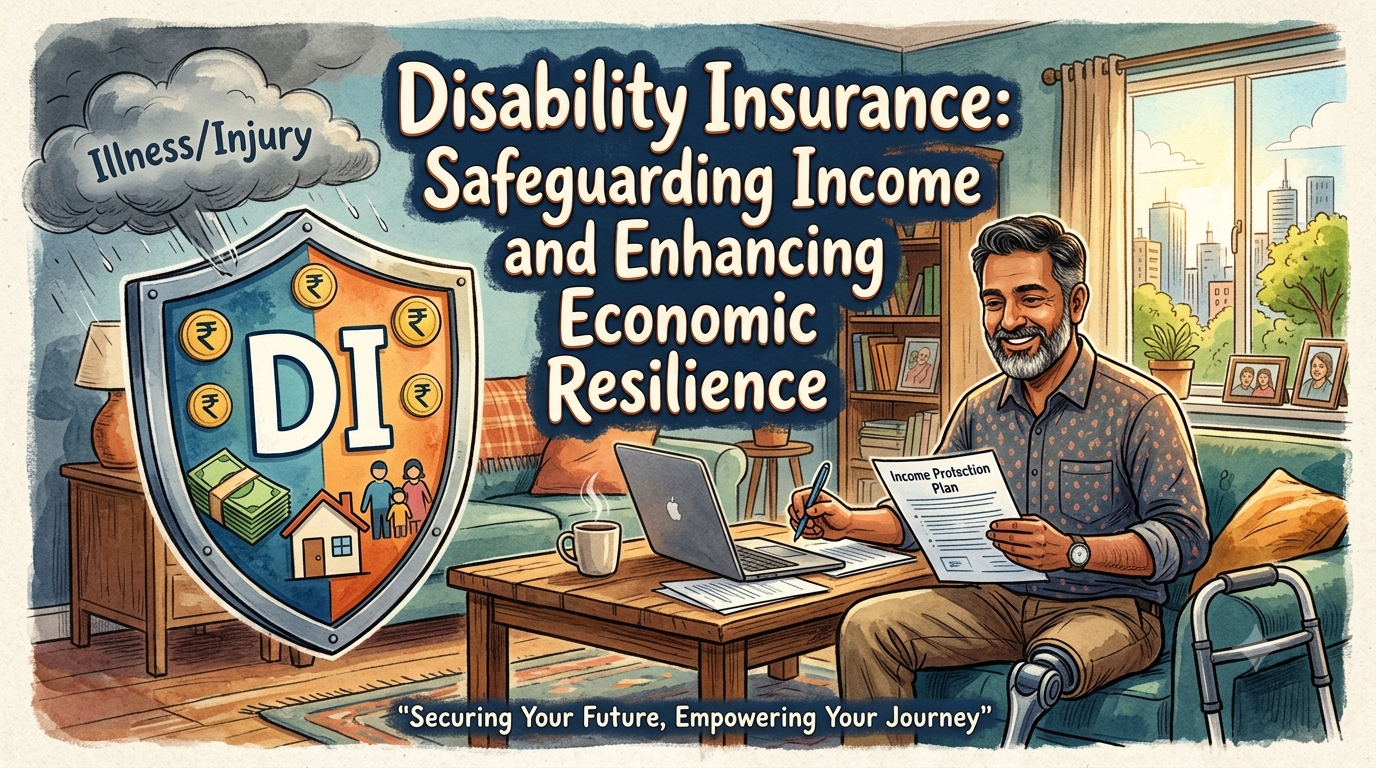
In the modern economic environment, where personal income serves as the primary source of livelihood, the risk of losing one’s ability to work due to illness or injury poses a serious financial threat. Disability insurance emerges as a vital risk management tool designed to provide income replacement when an individual becomes unable to earn a living due to a disability.
Unlike life insurance, which provides financial benefits after death, disability insurance protects against the living risk — the loss of income during one’s working years. It ensures continuity of financial stability for individuals and their families, supporting expenses such as mortgage payments, healthcare, education, and daily living costs.
For organizations, governments, and policymakers, disability insurance is also a mechanism to promote workforce welfare, reduce poverty risk, and maintain macroeconomic stability in the face of health-related disruptions.
2. Concept and Definition of Disability Insurance
Disability insurance is a type of income protection policy that provides periodic payments to an insured individual who cannot work due to a medically certified disability — whether temporary or permanent, partial or total.
It is built on the principle of income indemnification, ensuring that an individual’s financial well-being is not severely compromised by the loss of earning capacity.
According to the Insurance Regulatory and Development Authority of India (IRDAI), disability insurance refers to “a policy that provides monetary benefits in the event of total or partial disablement caused by accident or illness, leading to loss of income.”
3. Objectives of Disability Insurance
The core objectives of disability insurance include:
- Income Replacement: To provide regular financial support during periods of work incapacity.
- Financial Protection: To cover essential expenses when earning potential is compromised.
- Economic Stability: To prevent personal bankruptcy and protect household economic security.
- Social Welfare: To reduce dependence on public welfare schemes or family support.
- Employer Responsibility: To promote workplace safety and employee well-being.
Essentially, disability insurance converts potential economic loss into manageable financial compensation.
4. Types of Disability Insurance
Disability insurance is classified based on coverage duration, cause, and policyholder type:
A. Based on Duration
- Short-Term Disability Insurance (STD):
Provides benefits for a limited period, typically from a few weeks up to six months. It is often employer-sponsored and covers temporary conditions such as fractures, surgeries, or short-term illnesses. - Long-Term Disability Insurance (LTD):
Covers disabilities lasting several years or until retirement age. It is designed for chronic illnesses, major injuries, or permanent disabilities that hinder long-term employability.
B. Based on Cause
- Accidental Disability Insurance:
Provides benefits only for disabilities resulting from accidents, such as road or workplace injuries. - Comprehensive Disability Insurance:
Covers both accidents and illnesses, offering broader protection.
C. Based on Policyholder Type
- Individual Disability Insurance: Purchased directly by individuals to protect personal income.
- Group Disability Insurance: Offered by employers or associations as part of employee benefits.
- Government-Sponsored Programs: Public welfare schemes such as Social Security Disability Insurance (SSDI) in the U.S. or Employees’ State Insurance (ESI) in India.
5. Key Components of Disability Insurance Policies
A disability insurance contract consists of several essential elements:
- Definition of Disability: Specifies what qualifies as a covered disability (e.g., inability to perform one’s occupation or any occupation).
- Benefit Amount: Typically 50–70% of pre-disability income.
- Elimination Period: The waiting period before benefits begin (commonly 30 to 90 days).
- Benefit Period: Duration for which payments are made (e.g., 2 years, 5 years, or up to age 65).
- Premiums: Depend on occupation, age, health, coverage amount, and benefit duration.
- Exclusions: Disabilities caused by self-inflicted injuries, substance abuse, or pre-existing conditions may be excluded.
This structured approach ensures balance between affordability, risk exposure, and long-term protection.
6. Economic and Social Importance of Disability Insurance
Disability insurance serves as a cornerstone of financial resilience and social protection. Its significance can be analyzed on multiple levels:
- For Individuals: Provides consistent income flow during illness or recovery, preventing depletion of savings or assets.
- For Families: Maintains household stability, ensuring essential expenses are covered.
- For Businesses: Reduces absenteeism-related productivity losses and fosters employee loyalty.
- For the Economy: Reduces public welfare burden, maintains consumer spending, and ensures economic continuity.
A study by the World Health Organization (WHO) indicates that nearly 15% of the global population lives with some form of disability. Among working adults, around 1 in 4 will experience a disabling condition before retirement — reinforcing the need for structured disability insurance systems.
7. The Global Disability Insurance Market
Globally, the disability insurance market is valued at approximately USD 350 billion (2024) and is projected to grow steadily due to aging populations, workplace hazards, and increasing health awareness.
Key Players:
- MetLife, Prudential Financial, Aflac, Unum Group, Allianz, AXA, and AIA Group.
Regional Insights:
- North America: The largest market, with strong employer-based and government programs.
- Europe: Universal healthcare integration supports both private and public disability coverage.
- Asia-Pacific: Rapidly growing market due to rising middle-class income and formal employment.
- India: Still under-penetrated; major players include LIC, HDFC Life, ICICI Prudential, and SBI Life.
In India, disability coverage often comes as a rider with term insurance or personal accident policies rather than as standalone plans, highlighting an emerging market opportunity.
8. Underwriting and Risk Assessment
Underwriting in disability insurance is complex because it evaluates the probability and duration of disability, not just mortality risk. Key factors include:
- Occupation Risk Class: Physical labor roles (construction, manufacturing) carry higher risk.
- Medical History: Pre-existing conditions, chronic illnesses, and mental health history.
- Lifestyle Factors: Smoking, alcohol consumption, and activity level.
- Age and Gender: Older individuals have higher risk and shorter benefit periods.
- Income Level: Determines the maximum insurable benefit.
Advanced technologies such as predictive analytics, AI-based medical screening, and wearable health data are enhancing underwriting accuracy and reducing claim disputes.
9. Claims Process and Management
The claims process in disability insurance involves multiple stages to ensure authenticity and fairness:
- Claim Notification: The insured informs the insurer of the disability event.
- Medical Verification: Medical professionals certify the disability’s nature and duration.
- Assessment: Insurer evaluates the claim against policy terms and occupation definition.
- Approval and Payment: Once validated, periodic benefits are disbursed.
- Review: Periodic reassessment ensures continued eligibility.
Digital platforms and telemedicine are increasingly used to streamline claims management and reduce administrative burden.
10. Marketing and Distribution Strategies
Insurance providers use a combination of traditional and digital distribution methods:
- Bancassurance: Partnering with banks for policy sales.
- Corporate Tie-ups: Offering group disability coverage to employees.
- Agents and Brokers: Educating customers about the importance of income protection.
- Online Platforms: Allowing direct purchase and policy comparison.
- Financial Advisors: Recommending disability insurance as part of holistic financial planning.
Marketing strategies often emphasize income continuity and family protection — emotionally resonant themes that influence consumer decisions.
11. Legal and Regulatory Framework
Disability insurance is subject to strict regulation to ensure transparency, solvency, and consumer rights.
In India:
The IRDAI regulates disability benefits, ensuring fair underwriting and claims practices. The Employees’ State Insurance Act (1948) provides statutory disability benefits for workers in organized sectors.
Globally:
- United States: Governed by the Social Security Act and Employee Retirement Income Security Act (ERISA).
- United Kingdom: Overseen by the Financial Conduct Authority (FCA).
- Canada and Australia: Have public-private hybrid disability income systems.
Regulatory oversight ensures compliance, fair pricing, and consumer trust in insurance systems.
12. Challenges in the Disability Insurance Industry
Despite its importance, disability insurance faces numerous challenges:
- Low Awareness: Many individuals underestimate the likelihood of disability during working years.
- Complex Policy Terms: Misunderstandings regarding coverage definitions and exclusions.
- Moral Hazard: Risk of exaggerated or fraudulent claims.
- Underinsurance: Many policies replace less than half of actual income.
- Data Limitations: Limited predictive data on disability frequency and recovery rates.
- Affordability: High premiums deter lower-income earners.
- Mental Health Coverage: Often excluded or inadequately defined.
These challenges highlight the need for consumer education and innovative product design.
13. Technological Transformation
Digital transformation is reshaping the disability insurance landscape through:
- Artificial Intelligence (AI): Automating underwriting and claim verification.
- Telehealth and E-Medical Reports: Enabling faster disability assessments.
- Blockchain: Preventing fraud and enhancing policy transparency.
- Wearable Devices: Monitoring health metrics for risk-based pricing.
- Mobile Apps: Offering instant claim filing and real-time policy management.
The integration of data-driven technologies enhances both insurer efficiency and policyholder trust.
14. Role of Disability Insurance in Employee Benefits
Employers increasingly recognize disability insurance as a key component of employee welfare programs.
Benefits include:
- Improved Job Satisfaction: Employees feel financially secure.
- Reduced Turnover: Enhances retention and loyalty.
- Corporate Social Responsibility (CSR): Reflects care for employees’ well-being.
- Productivity Continuity: Ensures financial stability during employee rehabilitation.
Multinational corporations often provide group disability plans as part of total compensation packages, positioning them as competitive talent retention tools.
15. Future Trends and Opportunities
The disability insurance industry is evolving with demographic, economic, and technological shifts. Key future trends include:
- Hybrid Coverage Plans: Combining accident, critical illness, and disability benefits.
- Income-linked Premiums: Adjustable premiums based on career stage and earnings.
- Behavior-Based Pricing: Rewards for healthy lifestyles tracked via wearables.
- Microinsurance Products: Affordable disability plans for informal sector workers.
- Government Partnerships: Expanding social insurance frameworks in developing economies.
- AI-Powered Predictive Models: Enhancing prevention and early detection of disabilities.
As global health awareness increases, disability insurance will become a mainstream component of personal financial planning.
16. Strategic Outlook and Conclusion
Disability insurance plays a dual role — as a personal safety net and as a macroeconomic stabilizer. It ensures that income, the most critical human resource, is protected from unexpected disruption.
In the post-pandemic world, where health risks and job insecurity have become more pronounced, the demand for disability insurance is rising across both developed and emerging markets.
From an MBA and business strategy perspective, insurers must focus on:
- Customer-centric product innovation
- Digital process integration
- Collaborative public-private models
- Sustainable risk management
Ultimately, the success of disability insurance lies in balancing financial sustainability with social responsibility, ensuring that every individual — regardless of occupation or income — has access to protection against the uncertainty of disability.
Through innovation, education, and inclusivity, disability insurance will continue to uphold its fundamental purpose: to secure dignity, stability, and financial continuity in the face of life’s most unpredictable challenges.